

There is a moment in every great film when the audience stops thinking about cameras.
The mountains feel ancient. The rivers seem untamed. The light appears too perfect to have been captured by human hands. The landscape ceases to be scenery and becomes a character in its own right.
Few viewers ever ask who made that possible.
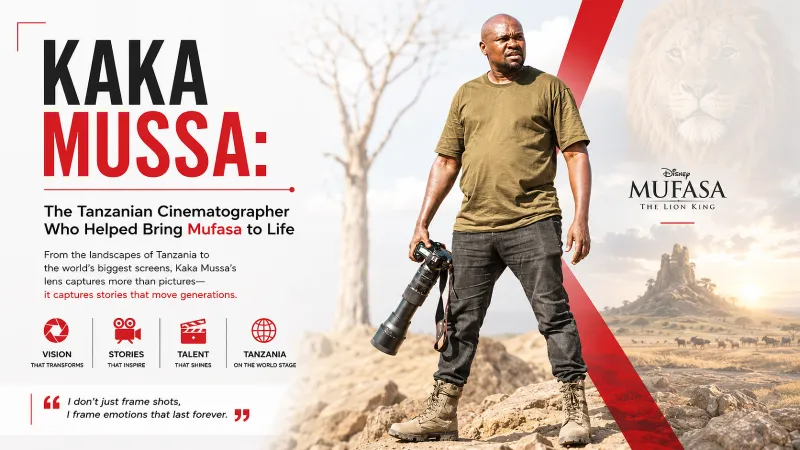
Behind many of those unforgettable cinematic moments are artists whose names never appear on billboards, yet whose work shapes how millions experience a story. Kaka Mussa belongs to that rare fraternity of filmmakers.
Known professionally as Mussa Ally, Kaka Mussa has spent years mastering the art of visual storytelling as a cinematographer, drone operator, vision mixer and technical filmmaker. His career has been built not on celebrity but on precision, the kind of precision that allows a single aerial shot to communicate wonder without a single spoken word.
That dedication eventually carried him to one of the world's biggest film productions.
When Hollywood Came to Tanzania
In 2019, Disney's production team began searching for landscapes capable of portraying the mythical world of Mufasa: The Lion King.
Although the film is a work of fiction, its emotional power depended on landscapes that felt authentic, vast plains, dramatic escarpments, volcanic lakes and ancient geological formations that could evoke the grandeur of Africa itself.
They found much of what they needed in Tanzania.
Rather than recreating every environment inside a computer, production teams travelled across the country to capture authentic reference footage and environmental imagery. Among the specialists selected for this technically demanding assignment was Tanzanian drone cinematographer Kaka Mussa.
His responsibility was not merely flying drones.
It required translating landscapes into cinematic language.
Every flight demanded an understanding of composition, weather, light, movement and geography. The objective was to capture Tanzania in ways that could later guide one of Hollywood's most sophisticated visual effects productions.
The result is extraordinary.
Reports indicate that a substantial portion of the environmental references used in Mufasa: The Lion King originated from Tanzanian locations, including iconic sites such as Lake Natron and the Isimila Stone Age landscapes.
Millions of viewers may never realise they have already admired Tanzania.
But they have.
An Invisible Art
Cinema often celebrates actors because audiences see them.
Cinematographers create something more elusive.
They shape what audiences feel.
The best camera operators disappear entirely behind their work. When viewers become emotionally immersed, they rarely think about focal lengths, flight paths or stabilisation systems. They simply believe the world unfolding before them.
That is the highest compliment a visual storyteller can receive.
For Kaka Mussa, filmmaking has always been an exercise in disciplined craftsmanship rather than personal attention. His professional background spans documentaries, television commercials, feature productions, drone cinematography, Jimmy Jib operations, Steadicam work and live broadcast vision mixing. Each discipline demands different technical skills, yet all share one common objective: telling stories visually.
Tanzania's New Creative Economy
His achievement represents something larger than one individual's success.
For decades, international productions viewed Africa primarily as a location.
Increasingly, they recognise Africa as a source of world-class creative talent.
The continent's filmmakers are no longer merely providing scenery.
They are becoming collaborators.
Kaka Mussa's involvement in a Disney production demonstrates that Tanzanian professionals possess the technical capability, artistic judgement and production standards required for projects operating at the highest international level.
That matters enormously for the country's growing creative economy.
Every successful collaboration strengthens Tanzania's reputation as a destination not only for tourism but also for global filmmaking, documentary production, advertising and digital media.
More Than Beautiful Pictures
Drone cinematography has transformed filmmaking.
Where helicopters once dominated aerial filmmaking, drones have democratised cinematic movement. Yet owning a drone is very different from creating cinema.
Professional aerial cinematography requires understanding aviation regulations, environmental conditions, camera dynamics, storytelling and production workflows.
Kaka Mussa represents a generation of African filmmakers who have embraced these technologies not as gadgets but as creative instruments.
His work illustrates that modern filmmaking is increasingly interdisciplinary, combining engineering, aviation, photography, computing and artistic intuition into a single profession.
Quiet Excellence
Some careers are measured by awards.
Others are measured by trust.
Hollywood productions are among the most demanding creative environments in the world. Every specialist selected for such projects carries significant responsibility because mistakes can cost millions of dollars.
Being trusted with that responsibility speaks volumes.
It reflects years of technical discipline, professional reliability and creative excellence developed long before international recognition arrived.
The Story Beyond the Credits
Most audiences stay only briefly when the credits begin.
Yet hidden among thousands of names are individuals whose work makes cinematic magic possible.
Kaka Mussa is one of them.
His contribution reminds us that Tanzania's greatest exports are not limited to minerals, wildlife or landscapes.
The country also exports talent.
Every frame he captured helped present Africa not as an imagined continent, but as a place of extraordinary beauty worthy of the world's biggest screens.
That is perhaps the quietest form of patriotism.
To show your country so truthfully that millions fall in love with it without ever knowing who held the camera.
For Kaka Mussa, that may be the greatest achievement of all.
Updated October 16, 2026





Be the first to share your thoughts.