

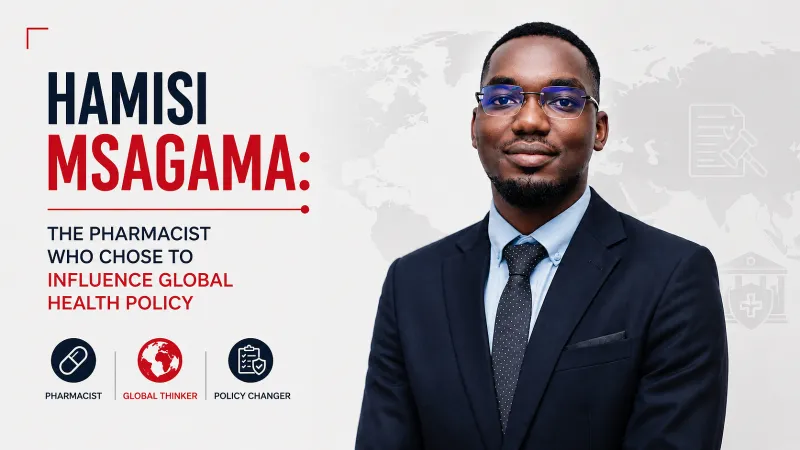
Some Prescriptions Are Written With Ink. Others Are Written With Policy.
Every day, somewhere in the world, a child dies because antibiotics no longer work. A mother travels hundreds of kilometres only to discover that essential medicines are unavailable. A disease that could have been prevented quietly becomes a national crisis. To many people, these appear to be isolated tragedies, individual stories of suffering separated by geography and circumstance.
Hamisi Msagama sees something different.
He sees systems instead of symptoms. He sees policies instead of isolated events. He understands that long before a patient walks into a hospital, decisions have already been made in cabinet meetings, parliamentary chambers, research institutions and international negotiations. Those decisions determine whether medicines exist, whether healthcare workers are trained, whether diseases are prevented, and whether millions of people ever receive care at all.
That perspective has transformed him from a young pharmacist in Tanzania into one of the country's emerging voices in global health, working at the intersection of science, public policy, diplomacy and international cooperation. While many healthcare professionals dedicate their careers to treating individual patients, Hamisi has chosen to strengthen the systems that determine the health of entire populations.
Before He Knew Global Health
Ironically, Hamisi's journey into global health began long before he knew the field even existed. As a pharmacy student at Muhimbili University of Health and Allied Sciences (MUHAS), he was driven less by a career plan than by an instinctive curiosity about the world beyond the classroom. He volunteered in community initiatives, participated in outreach programmes and constantly asked questions that extended far beyond pharmacology.
That curiosity quickly evolved into leadership.
During his first year, fellow students elected him Deputy Minister responsible for Research, Innovation and Community Outreach within the student government. The position offered more than administrative responsibility; it introduced him to the idea that leadership could influence public health just as powerfully as scientific expertise. Even then, it was becoming clear that his impact would extend far beyond laboratories and lecture halls.
Leading Five Thousand Future Pharmacists
Leadership accelerated rapidly. By his third year, Hamisi had been elected President of Tanzania's Pharmaceutical Students, representing more than 5,000 pharmacy students across the country. The role was never about status or recognition. It became a platform for confronting one of the fastest-growing threats facing global healthcare: antimicrobial resistance.
At a time when many still viewed antibiotic resistance as a technical issue reserved for pharmacists and clinicians, Hamisi recognised its far wider implications. Antimicrobial resistance threatened agriculture, animal health, food security, economic productivity and even national security. It was not simply a medical challenge; it was a development challenge capable of affecting every sector of society.
Long before "One Health" became a widely recognised global framework, he was already advocating for the interconnected thinking that defines it today, recognising that the health of people, animals and the environment can never be separated.
When a Pandemic Changed Everything
Then COVID-19 changed the world.
While much of society came to a standstill, Hamisi's work intensified. He joined community sensitisation initiatives alongside Tanzania's Ministry of Health, contributed to the implementation of the National Action Plan on Antimicrobial Resistance, and later served within national technical working groups while representing youth voices during the review of Tanzania's National Master Plan for Neglected Tropical Diseases.
These responsibilities did more than expand his professional experience. They clarified his purpose.
Healthcare, he realised, was never only about dispensing medicines. It was about shaping the policies, institutions and systems that determine whether medicines, prevention and quality care reach communities in the first place.
Becoming More Than a Pharmacist
Many professionals spend decades mastering a single discipline. Hamisi deliberately chose to broaden his perspective. Receiving the prestigious Chevening Scholarship from the UK Government enabled him to pursue a Master's degree in Global Health at Brighton and Sussex Medical School, where he specialised in access to medicines and the economic evaluation of healthcare.
The experience transformed the questions he asked.
Instead of asking only how diseases are treated, he began asking how health budgets are allocated, why essential medicines remain inaccessible to millions, how political leadership shapes health outcomes, and how scientific evidence becomes national legislation. Those questions shifted his career from understanding disease to understanding decision-making itself.
The Space Between Health and Politics
Many people in healthcare believe evidence changes the world.
Hamisi believes evidence changes the world only when it is translated into policy, and when that policy is backed by political commitment and sustained investment.
That translation rarely happens inside hospitals. It happens inside ministries, parliamentary committees, treasury negotiations, international organisations, diplomatic forums and cabinet discussions. It is in these spaces that research becomes legislation, legislation becomes investment, and investment ultimately becomes better health outcomes for millions of people.
This conviction increasingly defines his work. By engaging policymakers, parliamentarians and international partners, he seeks to bridge one of healthcare's greatest challenges: the gap between scientific evidence and public policy.
Updated October 15, 2026



Every pharmacy and public health student should read this. There are so many valuable lessons in Hamisi’s journey.
Every pharmacy and public health student should read this. There are so many valuable lessons in Hamisi’s journey.
I really admire his decision to move beyond direct patient care and focus on strengthening health systems. That kind of impact is remarkable.
This is the kind of story that broadens our perspective. Congratulations, Hamisi, for representing Tanzania on the global stage.