

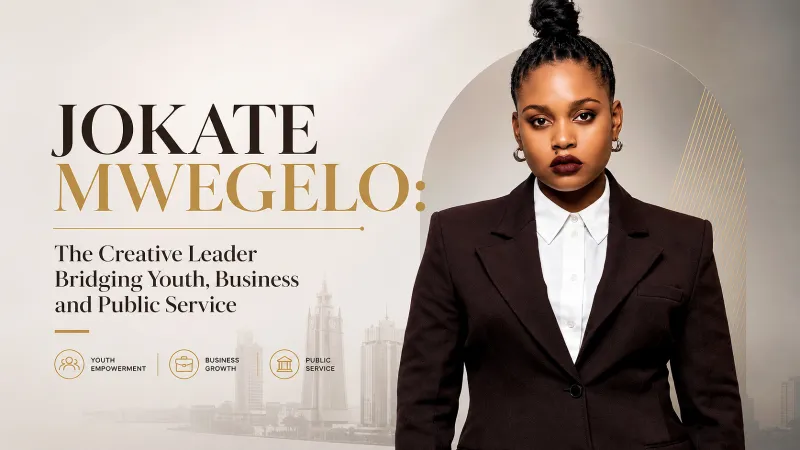
There is a particular kind of person who treats each stage of their life not as a destination but as an education, who moves between worlds without quite belonging to any single one of them, accumulating a breadth of experience that other people mistake for restlessness but which is, on closer inspection, the deliberate preparation for something that has not yet been named. Jokate Mwegelo is that kind of person, and the institution she has built is the thing she was preparing for, though it took two decades of building other things before she understood that clearly enough to say so.
She was born in Washington DC on 20 March 1987 to Tanzanian parents, and grew up in Dar es Salaam in the particular way that a child who belongs to two places grows up, with a wider frame of reference than most and a refusal to accept that the way things are in one place is the only way they could ever be. She studied Political Science and Philosophy at the University of Dar es Salaam, a combination that tells you something about how her mind was already working: the first discipline concerned with how power is organised in the world as it exists, the second with how the world ought to be organised if you were reasoning from first principles. That tension between the actual and the possible would run through everything she did afterward.
Her first encounter with national attention came through Miss Tanzania in 2006, where she finished as second runner-up, and through the television work that followed, which gave her something more durable than a title: a following, and a gift for communication that would prove useful in every subsequent chapter of her life in ways she could not have anticipated at the time. It would be easy to dismiss this period as the glamorous preamble to a more serious career, and many accounts of her life do exactly that, treating the entertainment years as a kind of prologue before the real story begins. That reading misses something important. The discipline of presenting yourself clearly and compellingly to large audiences, of understanding what holds people's attention and what loses it, of making an argument feel like an invitation rather than an instruction, is not a trivial skill, and Jokate carried it forward into every room she entered afterward.
She was already building Kidoti when the television work was still at its height, which is itself a telling detail. Her first business was a hair company, founded on the observation that Tanzanian women were buying products that had been designed for someone else's hair by someone who had never set foot in Dar es Salaam, and that the gap between what was available and what was actually needed was wide enough to build something in. Kidoti Hair was the answer to that gap, and the instinct that produced it, the instinct to look at a market that is not being served properly and to ask why someone has not fixed this yet, would prove to be the most consistent characteristic of her professional life. The company expanded, earned Jokate a place on the Forbes Africa 30 Under 30 list in 2017, and established her as one of the more credible voices on African entrepreneurship in a landscape crowded with people talking about it and far fewer actually doing it.
Public service arrived in 2018 with her appointment as District Commissioner for Kisarawe, and with it came the encounter that would eventually produce Kidoti Foundation. She arrived expecting to find the ordinary challenges of local administration. What she found instead, when she went into schools and sat with teachers and parents and girls who were still attending but understood how provisional that attendance was, was a problem so specific and so solvable that its continued existence felt almost inexplicable. Girls were leaving secondary school not because they lacked the ability to complete it but because there was no safe place for them to sleep within a reasonable distance of where they studied, and the calculation their families were forced to make, weighing the cost and risk of a journey taken twice daily against the value of an education that might not lead anywhere they could see, was resolving consistently in favour of keeping daughters at home. Jokate looked at this situation and concluded that it was not a tragedy requiring sympathy. It was an infrastructure problem requiring a building.
The campaign she ran to build that building, which she named Tokomeza Zero, meaning bring the dropout rate to zero, raised one billion Tanzanian shillings from communities and partners and individuals who gave not because they were persuaded by a fundraising document but because they had lived the problem themselves or watched it consume someone they loved. The school that those contributions built now has residential capacity for four hundred and sixty girls, who sleep there and study there and sit their examinations there and leave with a secondary education that the district's own statistics had effectively written off as unlikely. She went on to serve as District Commissioner for Temeke and later Korogwe, accumulating in each posting a deeper understanding of the relationship between local government, community capacity and the specific, granular nature of the barriers that prevent ordinary Tanzanians from reaching the lives they are capable of living.
What she carried away from a decade in public administration, alongside the later roles she held within CCM's women's and youth wings, was a clarity about what development actually requires that is difficult to arrive at from a distance. Development requires specificity, the willingness to identify a single concrete barrier and remove it rather than writing a framework that addresses everything at the level of principle and nothing at the level of practice. It requires trust in communities to understand their own circumstances and to fund their own solutions when given a structure that makes that possible. And it requires an institutional patience that outlasts any single funding cycle, any single leadership tenure, any single moment of political goodwill.
Kidoti Foundation is the institutional expression of everything she learned. It is also, and this is a fact she does not keep at arm's length, something she is building for her daughter, who was born in 2022 and is growing up inside a country whose opportunity gap her mother has chosen to spend her life closing.
"People ask me when I decided to start the foundation, and the honest answer is that I am not sure I did decide, in the way people imagine decisions being made. What happened is closer to recognition than to choice. I had spent years in districts where the difference between a girl who finished school and a girl who did not had nothing to do with how intelligent she was or how much her parents wanted her to succeed. It had to do with a road, or a building that did not exist, or a calculation made at the kitchen table by people who loved their daughter and had no good options. When I finally understood that these were not tragedies I had to witness but problems I could structure a solution around, everything I had done before suddenly made sense in a way it had not before. The television years taught me how to get people to listen. The business years taught me that you build things by finding the gap and walking into it. The government years showed me where the gaps were. The foundation is what you get when you put those three things together and stop waiting for someone else to do it."
The programmes the foundation runs, across education, leadership development, girls' empowerment, entrepreneurship, sports and community innovation, are all answers to the same question she has been asking since she looked at the hair care market in Dar es Salaam two decades ago and found it wanting: what should exist here that does not yet, and what would it take to build it?
Updated October 16, 2026


Be the first to share your thoughts.