

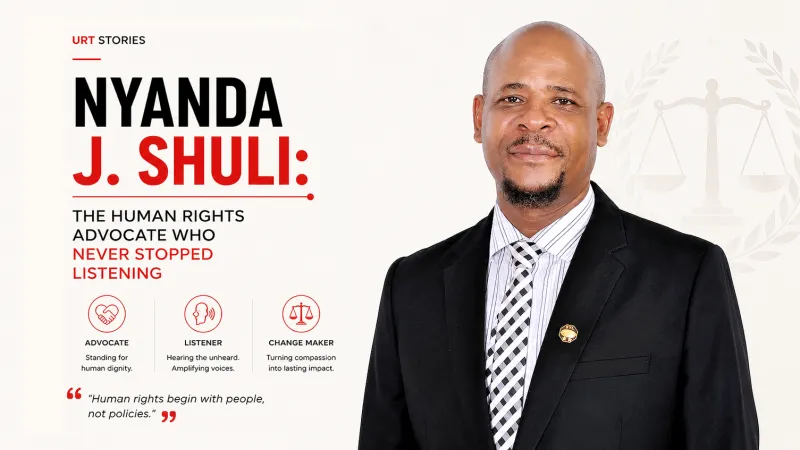
From journalism, education advocacy and strategic communication to one of Tanzania’s highest human rights institutions, Nyanda J. Shuli has spent more than two decades challenging injustice and reminding institutions that behind every complaint is a human life.
Long before he understood the formal language of human rights, Nyanda J. Shuli understood injustice.
As a young boy growing up in Tanzania, he was deeply troubled by inequality, discrimination, exclusion and unfair treatment. He instinctively believed that every person deserved dignity, opportunity and equal treatment. At the time, he could not have known that these convictions would eventually define his life’s work. He simply knew that whenever he encountered injustice, something within him demanded that it be challenged.
Years later, after graduating from the University of Dar es Salaam with a Bachelor of Arts with Education, a promising teaching career appeared to be the natural path ahead. His family, relatives and friends expected him to become a teacher.
But his heart pointed elsewhere.
“I wanted to have an impact in communities,” he recalls.
Shuli taught for six months after graduation, but it did not take long for him to recognise that his ambitions extended beyond the classroom. Inspiring students was meaningful, yet he longed for an opportunity to engage with society on a broader scale, to challenge the structures shaping people’s lives and help communities claim better futures.
The journey that followed was anything but predictable.
The Newsroom That Opened a New Door
Rather than moving directly into community development or human rights advocacy, Shuli found himself working as a young journalist.
Looking back, he considers journalism an unexpected but defining chapter of his career. The newsroom strengthened his ability to communicate clearly, introduced him to the discipline of gathering and verifying evidence, and deepened his understanding of public affairs.
It also taught him that facts could do more than inform.
When presented with courage, clarity and purpose, evidence could challenge power, influence public debate and move institutions towards action. Journalism became more than a profession; it became his introduction to evidence-based advocacy.
Most importantly, it opened the door to civil society.
Shuli joined HakiElimu, one of Tanzania’s leading education advocacy organisations, where his longstanding commitment to social justice found a natural home. During the nine years that followed, he became closely involved in national campaigns calling for equitable access to quality education.
One campaign captured the public imagination with particular force.
Two Children, Two Different Futures
Widely known as the "Kayumba Campaign" or "Two Worlds," the campaign originated from a communication concept developed by Shuli and was subsequently implemented and managed in collaboration with his colleagues in HakiElimu's Media Programme.
The campaign presented two children beginning life from dramatically different educational circumstances.
One was a girl attending a well-equipped private school, surrounded by books, qualified teachers, and the resources necessary to learn. The other was a boy from a disadvantaged family trying to study in an under-resourced public school.
The contrast was deliberately uncomfortable.
It demonstrated how children's futures were often shaped not by their intelligence, effort, or potential, but by the circumstances into which they had been born. Two equally deserving children could enter the education system with entirely different chances of succeeding.
Across Tanzania, the message resonated.
The campaign stimulated national conversation, informed policy debate, and contributed to the broader reform discourse that shaped Tanzania's education sector during the mid-2000s. It also demonstrated how strategic communication could transform a complex public policy issue into a compelling human story that resonated with citizens and decision-makers alike.
For Shuli, the experience reinforced an enduring lesson: people respond to policy issues differently when they can see the human beings behind the statistics.
While working at HakiElimu, he further strengthened his professional expertise by earning a Master's degree in Communication from The Hague University of Applied Sciences in the Netherlands. The programme equipped him with a strong foundation in strategic communication, particularly in its practice through corporate communication and marketing communication, expertise that would later underpin much of his leadership and professional work.
His growing reputation as a communication strategist and social justice advocate eventually led him to one of Tanzania's highest public-service institutions.
From Advocacy to National Public Service
In 2019, Shuli was appointed Commissioner of the Commission for Human Rights and Good Governance.
He served two terms, concluding his tenure in January 2026. During those years, he devoted himself to promoting and protecting human rights while advancing the principles of accountability and good governance across Tanzania.
The position brought investigations, institutional inspections, public engagements and official responsibilities. It placed him inside rooms where consequential decisions were discussed and required him to confront complaints involving institutions, systems and the people affected by them.
Yet when asked what he remembers most vividly about serving as Commissioner, Shuli does not speak first about formal meetings, official ceremonies or prestigious assignments.
His answer comes without hesitation.
“It was not the meetings or the official ceremonies,” he says. “It was the people.”
One encounter, in particular, gave those words profound meaning.
“Commissioner, You Saved My Life”
In early 2026, Shuli travelled to Tanga. During the visit, a man approached him and asked whether he remembered him.
Shuli studied his face but could not place him.
“I couldn’t remember where I had met him,” he admits.
Then, overcome with emotion, the man said quietly:
“Commissioner, you saved my life.”
The statement caught Shuli by surprise. He asked the man to explain.
The stranger told him that he had once been incarcerated in Morogoro Prison, serving a life sentence. In 2024, Shuli had visited the prison as part of a multidisciplinary inspection team that included representatives from the Police Force, the prosecution authorities, social welfare services and the Judiciary.
During that inspection, the prisoner had raised a troubling complaint. He had filed an appeal against his conviction, but the case had remained unheard for an unusually long time. His future was trapped inside an unresolved legal process, and he did not know whether anyone outside the prison walls was paying attention.
Shuli listened.
Recognising the seriousness of the matter, he asked the representative from the prosecution authorities to investigate the delay and report back. That intervention triggered follow-up action and helped move the appeal process forward.
Eventually, the Court of Appeal heard the case, overturned the conviction and acquitted the man.
Years later, standing before Shuli in Tanga as a free man, the former prisoner had come to express his gratitude.
For Shuli, the encounter distilled the true meaning of public service into a single human moment. What may initially have appeared to be another complaint recorded during an official inspection had, in reality, represented a person’s freedom, future and entire life.
“They remind you,” he reflects, “that behind every file, every complaint and every investigation is a human being whose life can change because someone chose to listen.”
Human Rights Beyond Government
Today, Shuli’s journey continues in a different arena.
A multidisciplinary scholar and practitioner, he is completing his Doctor of Philosophy. His research examines how responsible business conduct and human capital development can improve the economic wellbeing of communities hosting mining operations in Tanzania.
The research represents a natural extension of his life’s work.
For decades, Shuli has examined how public institutions, education systems and governance structures affect the dignity and opportunities available to ordinary people. He is now bringing those same concerns into the relationship between businesses and the communities in which they operate.
For him, responsibility for protecting human dignity does not rest with governments alone.
Businesses also shape lives. Their decisions can determine whether communities gain meaningful employment, develop sustainable skills, access economic opportunities and participate fairly in the value created from local resources. Responsible business conduct must therefore go beyond regulatory compliance or occasional charitable projects. It should influence how companies engage communities, develop human capital and contribute to long-term prosperity.
This is especially important in mining communities, where valuable natural resources may coexist with unemployment, limited opportunities and persistent economic hardship. Shuli’s research asks an urgent question: how can investment in human capital and responsible corporate behaviour ensure that the people living closest to Tanzania’s mineral wealth experience tangible and sustainable improvements in their lives?
It is a question rooted in the same conviction that disturbed him as a child.
The Courage to Listen
Nyanda J. Shuli’s career has crossed classrooms, newsrooms, civil society organisations, public institutions and academia. At first glance, these may appear to be separate professional worlds. Yet a single thread connects them all: the determination to confront inequality and help institutions recognise the human consequences of their decisions.
Journalism taught him to search for evidence.
Civil society taught him to transform evidence into advocacy.
Public service taught him that listening can alter the course of a person’s life.
Academia is now giving him another platform through which to explore how institutions and businesses can create fairer, more sustainable communities.
After more than two decades of service, the conviction that first stirred within him as a young boy remains unchanged: every person deserves dignity, fairness and the opportunity to build a better life.
Sometimes, defending that conviction requires a national campaign. Sometimes, it requires institutional reform, rigorous research or the courage to challenge established systems.
And sometimes, it begins with something deceptively simple:
Someone choosing to listen.
For readers interested in exploring how Shuli’s lifelong commitment to dignity and fairness is now shaping his academic work, his recent research examines the relationship between corporate social responsibility and the wellbeing of communities. The study extends the central conviction of his story, that institutions and businesses must never lose sight of the people whose lives are affected by their decisions. Read his published research here: Corporate Social Responsibility and Community Wellbeing
Updated October 17, 2026

Be the first to share your thoughts.