

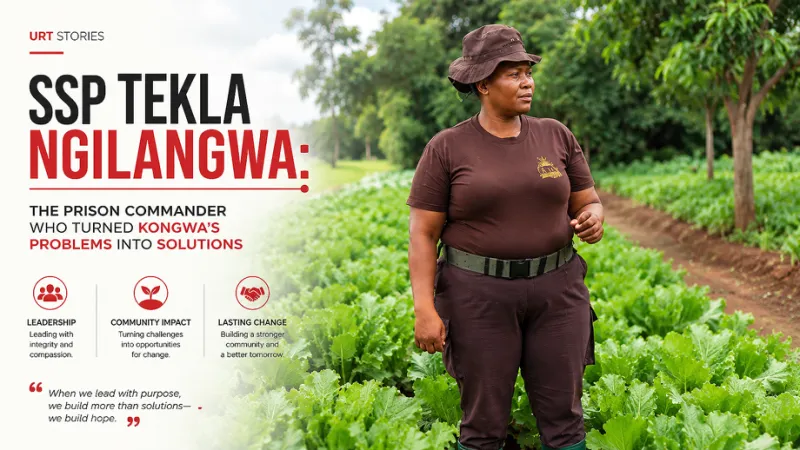
The Institution She Inherited
When SSP Tekla Erasto Ngilangwa reported to Kongwa District Prison on June 2021, following her appointment as Officer in Charge by the Commissioner General of Prisons, she did not arrive at an institution without activity. The prison was functioning. Officers performed their daily duties, while inmates cultivated groundnuts, sunflower and maize as part of their regular work. Yet the results remained limited, and both daily operations and development depended heavily on government funding.
The deeper challenge was visible in the physical condition of the prison. Its buildings and staff houses had aged after long periods without substantial renovation. But the problem extended beyond walls and roofs. According to the account supplied for this story, work was often measured by time served rather than results achieved. Routine had gradually become a culture, and the possibility of meaningful change appeared distant.
Relationships with government institutions, private organisations and the surrounding community were also limited. That distance did more than isolate the prison; it closed the door to knowledge, cooperation and opportunities that could have supported both rehabilitation and institutional development.
A Change of Mind Before a Change of Place
Ngilangwa understood that a different future could not be built by repairing buildings alone. Before Kongwa could transform physically, its officers and staff had to see the institution differently. She began by challenging the belief that the prison’s difficult conditions were permanent, or that those stationed there had been sent to endure rather than to build.
Her message was direct: Kongwa could accomplish ambitious work, strengthen the rehabilitation of inmates and create development that served both the Tanzania Prisons Service and the country. From that conviction came a slogan that would define the new approach: “Kongwa Problem, Kongwa Solution.”
The words were simple, but the philosophy was demanding. A problem was no longer merely something to report or wait for someone else to solve. It was an invitation to examine the people, land, skills and partnerships already available, and use them with imagination.
Discipline became central to the effort. Ngilangwa impressed upon officers that lasting progress required professional conduct, consistent performance and a willingness to make sacrifices before enjoying the results. In this new culture, discipline was not treated only as obedience to rules. It became the bridge between ambition and delivery.
Opening the Prison to Partnership
The next transformation occurred at the prison’s boundaries. Rather than allowing Kongwa to remain institutionally enclosed, Ngilangwa cultivated closer relationships with government bodies, private institutions and local communities. She believed progress depended on people and that no institution could fulfil its mission by operating inside a box.
Those relationships expanded the prison’s ability to pursue development. They also began to change how members of the public understood the Tanzania Prisons Service, not simply as a system of confinement, but as an institution capable of rehabilitation, production, public service and cooperation.
Turning Work into Rehabilitation
Once the internal mindset and external relationships began to shift, Kongwa launched a broad portfolio of productive projects. Agriculture was improved to raise the output of maize, groundnuts and sunflower, while a cashew farm was revived. Cement-block production was introduced at the prison and at Mkoka Camp. Two wells were drilled to serve inmates, remand prisoners, officers, staff and nearby communities, while also supporting drip irrigation at Manyata Camp.
The prison expanded into modern livestock keeping, including dairy cattle, poultry and goats. It established nurseries for fruit, timber and shade trees; developed beekeeping and welding activities; operated a cleaning project at Kongwa District Hospital; and created a prison shop and dining facility. A clean-energy project producing alternative charcoal was also introduced.
Seen separately, these may appear to be ordinary enterprises. Together, they formed a practical rehabilitation system. The projects gave inmates structured work, transferable skills and the experience of producing something useful. Officers supervised and taught them, turning farms, workshops and construction sites into classrooms without walls.
Rehabilitation became something inmates could practise with their hands.
What the Projects Built
The income, materials and capabilities generated through these initiatives were channelled into visible improvements. The prison underwent major renovation, including upgrades to the kitchen used to prepare food for inmates and remand prisoners, the Officer in Charge’s office, the wider administration offices and the commander’s residence. Some officers’ and staff houses were also rehabilitated.
New construction widened the impact. Three innovative two-in-one residential houses were built, together with a modern quarter guard, a prison dispensary and a maternal-and-child health building. At Manyata Camp, a house was constructed and an inmate dormitory renovated. The prison also built a modern dairy-cattle shed and a hall at its dining facility.
Other improvements included the restoration of an Isuzu vehicle identified in the source document as MT 0290, upgrades to irrigated gardens and tree nurseries, and broader environmental conservation work. Modern farming methods produced stronger harvests, helping the prison reduce the government’s food burden by supplying part of its own maize and sunflower requirements.
The significance of this progress was not limited to cost savings or infrastructure. Much of the work was carried out by inmates under the instruction and supervision of officers. The same projects that rebuilt Kongwa also equipped inmates with knowledge, routines and practical abilities intended to support personal reform.
Recognition, and a Place Others Came to Learn From
Kongwa’s environmental and institutional improvements attracted recognition. The source report records an environmental-conservation award presented by former Prime Minister Mizengo Pinda, as well as a certificate of commendation for the prison’s development and transformation presented by the Minister for Home Affairs in May 2024.
The prison also became a place visited for inspection, learning and exchange. The report identifies visitors including Kongwa District Commissioner Mayeka Saimon Mayeka; Kiteto District Commissioner Remidius Mwema and the Kiteto Security Committee; regional prison leadership and station heads from Lindi and Morogoro; and prison commanders from Kiteto, Mpwapwa and Kondoa, among others.
That reversal matters. An institution once constrained by deteriorating facilities and limited connections had begun to attract people seeking lessons from its experience.
A Different Meaning of Security
The transformation described at Kongwa produced more than new assets. Officers and inmates developed a stronger sense of possibility, discipline reportedly improved, and cooperation with public institutions, private organisations and surrounding communities became closer. The prison’s projects also provided services and economic opportunities connected to blocks, gardens, tree nurseries, livestock, the dispensary, dining facility and shop.
The account further states that inmates benefited from more professional rehabilitation and that repeat imprisonment declined. Although the document does not provide numerical data with which to measure that change, its central claim is important: correctional success should not be judged only by security inside the walls, but by the capacity of people to return to society better prepared than when they entered.
For local residents, the projects helped make the prison service more approachable and weakened the idea of prison as a place defined only by suffering. For government, increased food production and institutional self-reliance offered a way to reduce pressure on public resources. For inmates, productive work became a pathway towards skill, responsibility and restored possibility.
The Leadership Lesson from Kongwa
Kongwa’s story is ultimately not about one renovation, one harvest or one award. It is about the sequence through which institutional change becomes possible. Ngilangwa began with mindset, reinforced it with discipline, extended it through relationships and converted it into projects whose results people could see.
Her approach did not pretend that resources were unlimited. It asked a harder and more useful question: what can be achieved with the resources, people and opportunities already within reach? The answer emerged gradually, in a rehabilitated office, an irrigated garden, a revived vehicle, a new dispensary, a trained inmate and a community beginning to see the prison differently.
“Kongwa Problem, Kongwa Solution” was more than a slogan. It was an operating principle: ownership before excuses, ingenuity before resignation and rehabilitation through purposeful work.
Sometimes the first structure a leader must rebuild is not a building. It is belief.
Updated October 17, 2026






Be the first to share your thoughts.