

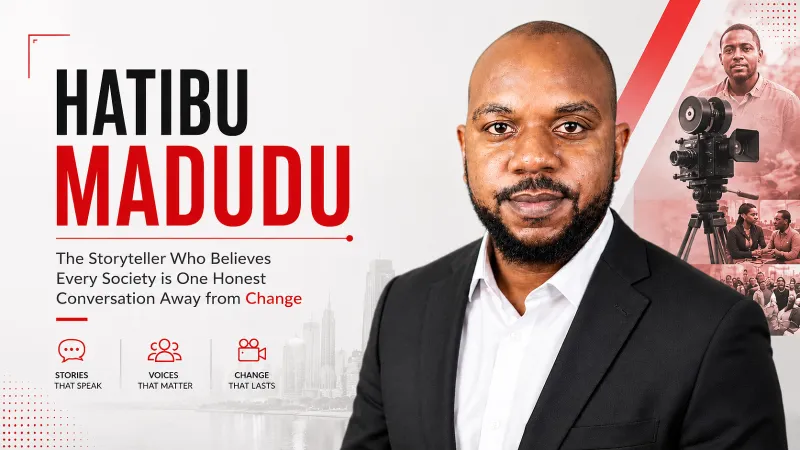
There are filmmakers who chase spectacle, filling cinema screens with explosions, impossible heroes and stories designed to help audiences escape reality. Then there are filmmakers who move in the opposite direction. They walk deliberately into the lives ordinary people often overlook. They search for uncomfortable truths hidden beneath everyday conversations. They ask difficult questions without raising their voices.
Hatibu Madudu belongs firmly to the second tradition.
His career has never been defined simply by making films. It has been defined by an enduring belief that stories can change societies before laws do, that culture often moves faster than politics, and that a camera, placed in the right hands, can become an instrument of public dialogue rather than mere entertainment.
Madudu entered the creative industry carrying the instincts of a social scientist rather than simply those of a filmmaker. Long before audiences saw his work on cinema screens, he had already developed a fascination with understanding how communities think, behave and evolve.
That academic foundation quietly shaped everything that followed.
His productions rarely begin with the question, “What will entertain people?”
Instead, they begin with a different question:
“What conversation is our society avoiding?”
That philosophy explains why his work consistently returns to issues of youth, identity, inequality, opportunity, governance, conservation and social transformation.
Throughout more than a decade in Tanzania’s media industry, Madudu has worked across radio, television, documentary filmmaking and feature films. His fingerprints can be found on public education campaigns, conservation programming, institutional documentaries, reality television and independent cinema. Rather than choosing between commercial production and public-interest storytelling, he has spent his career proving they can coexist.
His breakthrough as a writer and director came with Sukari in 2018.
The film confronted youth economic hardship and the difficult choices that poverty often forces upon young people. Instead of simplifying those realities into heroes and villains, Madudu explored the moral ambiguity that accompanies desperation. The film premiered at the Zanzibar International Film Festival before earning international recognition, including selection for FESPACO, Africa’s most prestigious film festival, introducing his voice to audiences far beyond Tanzania.
Recognition, however, never appeared to become the destination.
It became permission to think bigger.
His later feature film Uncle continued that trajectory, receiving awards at the Zanzibar International Film Festival and attracting regional attention, while his work as line producer on Katope, part of Netflix and UNESCO’s African Folktales Reimagined anthology, connected Tanzanian filmmaking to one of the world’s largest streaming platforms.
These milestones mattered not merely because they elevated one filmmaker.
They demonstrated that Tanzanian stories could travel internationally without abandoning their identity.
Perhaps the most remarkable aspect of Madudu’s journey is that he has never confined himself to directing films alone.
He has trained journalists in community radio stations across Tanzania, mentored emerging filmmakers, designed media capacity-building programmes and worked with civil society organisations, government institutions and development partners to communicate complex social issues through compelling storytelling. Whether in the studios of Dar es Salaam or community stations in Mbeya, Kigoma, Pemba and Ruvuma, his work reflects a consistent commitment to strengthening the country’s storytelling ecosystem rather than merely advancing his own career.
That commitment eventually led him to one of East Africa’s most influential cultural institutions.
As Festival Director of the Zanzibar International Film Festival (ZIFF), Madudu inherited responsibility for an event that has, since 1997, served as one of Africa’s leading platforms for cinema, cultural exchange and artistic dialogue. The role extends well beyond organising screenings. It requires identifying emerging voices, building international partnerships and ensuring that African filmmakers remain authors of their own narratives in an increasingly globalised media landscape.
For him, ZIFF is more than a festival.
It is an institution where African imagination negotiates its future.
His own ambitions continue to evolve accordingly.
Among the projects he has developed is Mavani, a feature centred on an emerging fashion designer determined to confront cultural dependency through fashion. Even in concept alone, the project reveals a recurring theme in Madudu’s work: the belief that questions of identity, culture and development are inseparable.
There is something quietly distinctive about his leadership.
He rarely presents storytelling as an industry alone.
He presents it as infrastructure.
Roads connect cities.
Electricity powers factories.
Stories connect generations.
Without them, societies lose memory, identity and imagination.
Without them, development becomes material but not cultural.
This philosophy has made Madudu not simply a filmmaker but one of Tanzania’s emerging architects of narrative infrastructure, someone helping build the institutions, talent and creative confidence necessary for African stories to flourish on their own terms.
His journey also reflects a broader transformation taking place across African cinema.
For decades, African filmmakers fought primarily for visibility.
Today’s challenge is different.
It is ownership.
Ownership of stories.
Ownership of audiences.
Ownership of cultural identity.
Ownership of the future.
Hatibu Madudu represents a generation increasingly determined to achieve all four.
In many ways, his greatest contribution may never be measured solely by awards, festivals or films.
It may instead be found in the young filmmakers he mentors, the journalists he trains, the conversations his stories provoke and the confidence with which Tanzanian creators increasingly tell their own stories to the world.
Because the most enduring storytellers do not simply entertain audiences.
They teach societies to recognise themselves.
And that has always been Hatibu Madudu’s real work.
“Before societies change their policies, they first change their stories.” — Hatibu Madudu
Updated October 16, 2026







Be the first to share your thoughts.