

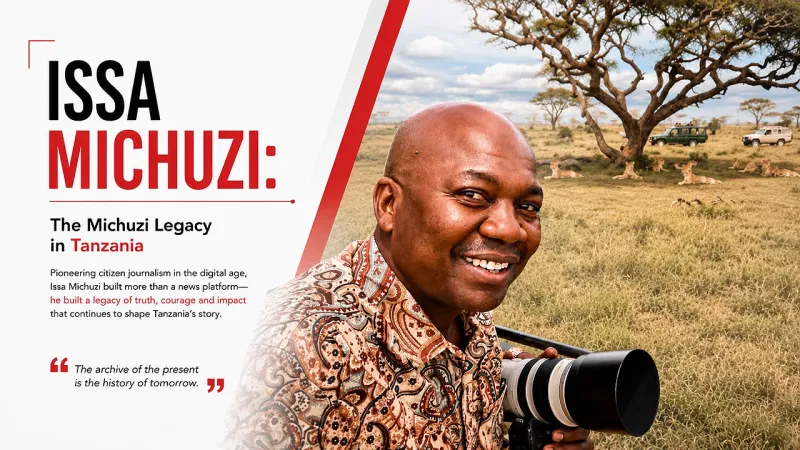
There is a particular kind of vanity in journalism that mistakes the front page for permanence; the ink dries, the paper yellows, and by the time anyone thinks to preserve it, it has already gone the way of Kariakoo's old timber shopfronts, remembered fondly, photographed rarely, and mourned properly only once demolished. Issa Michuzi understood something the rest of Tanzanian media was slow to grasp: that the archive of the present would have to be built while the present was still happening, or it would not be built at all.
It is worth stating plainly what is easy to forget in an age when every second Tanzanian with a smartphone fancies himself a publisher: in the mid-2000s, when broadband was a rumour and most newsrooms still measured their reach by circulation vans, what Michuzi was building at Michuzi Blog had no local precedent. It was reporting continuously rather than daily; it was reporting from everywhere rather than from a newsroom; and it was reporting for the diaspora as much as for the man queuing at the Ubungo bus stand. This was not merely early blogging, it was an entirely different relationship between the Tanzanian public and the news that concerned it.
His path into this was not an academic detour but a deliberate education in the craft. Michuzi graduated in 1994 from the Tanzania School of Journalism, the School of Journalism and Mass Communication at the University of Dar es Salaam, having already, in 1992, attended a photography course at the Berlin Institut für Journalismus in Germany. In 1996 he returned to further training abroad, this time a specialised course in digital photography run by the Thomson Foundation at Cardiff University in Wales, at a moment when digital image-making was still a novelty even in newsrooms with far deeper pockets than Tanzania's. That sequence, local grounding, then two separate rounds of international specialisation, one analogue and one digital, reads in hindsight like an apprenticeship built for exactly the transition Tanzanian media was about to undergo.
That training found its first professional home at the Daily News, where Michuzi spent nine years, initially as Chief Photographer and later as the paper's first Online Editor, a title that did not quite exist yet in Tanzanian journalism when he took it up. It was during these years that he built his reputation covering presidential activity both at home and abroad, first under Ali Hassan Mwinyi and then through the Benjamin Mkapa presidency, assignments that demanded a journalist equally comfortable behind a camera and at a keyboard. That dual fluency, sharpened further by an equal command of Swahili and English, made Michuzi something of a rarity in Tanzanian newsrooms: a one-man operation who could file the photograph and write the story himself, doing competently what editors elsewhere assumed required two separate hires. It was, quite apart from being a mark of individual skill, the more economical and practical option for any newsroom or state office that could get away with it, which is a large part of why the arrangement followed him for the rest of his career.
The progression, from the darkroom to the dial-up connection, was a natural extension of the Cardiff training in particular: a photographer schooled in digital workflow was better placed than most of his contemporaries to recognise what an always-on online edition could become. Michuzi Blog was, in effect, that recognition pointed at a public that had never been addressed so directly or so often.
When you launched Michuzi Blog in 2005, did you imagine you were simply creating an online news platform, or do you now see it as something much larger in Tanzania's history?
When I launched Michuzi Blog on 8 September 2005, I wasn't trying to make history. I was simply responding to a need. My immediate goal was practical. Whenever I travelled, particularly to Europe and North America, Tanzanians living abroad kept asking me the same question: "Why can't we access reliable news from home every day? Why are Kenya and Uganda already online while Tanzania is still behind?" Those conversations convinced me there was a real need that had not yet been addressed.
At the same time, I wanted a place where I could preserve my own journalism. After years as a photographer and reporter, I understood how easily important photographs and stories disappeared once newspapers were printed and filed away. The internet offered an opportunity to keep that work alive.
What followed exceeded anything I had imagined. The audience grew steadily until Michuzi Blog became one of the most widely read Swahili digital news platforms in the world. It stopped being just my platform and became part of people's daily lives. Readers returned not only for breaking news but also for community announcements, public events, sports, business, diplomacy and the ordinary moments that collectively tell the story of a nation.
Looking back today, I believe the blog's greatest achievement is not simply that it pioneered digital journalism in Tanzania. Its greatest contribution is that it unintentionally documented nearly two decades of the country's contemporary history in real time. Every photograph, every article and every daily update became another piece of Tanzania's collective memory.
History is often imagined as something created by presidents, wars or major political events. In reality, history is also built quietly, one photograph, one story and one ordinary day at a time. Looking back now, I realise that is what Michuzi Blog became.
What the blog produced, almost as a by-product of its daily hustle, was an archive, thousands of photographs of state functions, business forums, diplomatic visits, and the unglamorous civic life of a nation going about its business. Nobody commissioned this archive; nobody budgeted for it. It accumulated the way silt accumulates at a river mouth, and it is only now, as Tanzania belatedly discusses how to preserve its cultural and institutional memory, in music, in football, in architecture, in media itself, that the scale of what was quietly assembled becomes apparent. Tanzanian commentators have made something of a habit lately of arguing that the country archives its dansi records and its football history badly, if at all. It seems only fair to note that Michuzi Blog was, without ceremony, doing the work the institutions were not.
There is also a less comfortable point worth making, in the manner of a slip fielder who stays a beat too long at the crease: pioneers rarely get remembered as pioneers while the innovation is still novel. It is only once the imitators arrive, and Tanzania's digital media landscape today is thick with them, that the original contribution comes into focus. The blog's real inheritance is not the traffic it once commanded but the template it left behind: that a single determined publisher, without institutional backing, could set the terms for how a country's citizen journalism and online advertising would eventually be built.
None of which is to dress the story in more nostalgia than it can bear. The blog era, like the dansi era and the era of the independent afternoon tabloid before it, belonged to its moment and has given way to another, podcasts, TikTok explainers, WhatsApp forwards masquerading as news. But every subsequent moment in Tanzanian digital media has built, whether it acknowledges it or not, on the ground Michuzi Blog cleared first: the expectation that news should be immediate, that ordinary events deserved coverage, and that the internet was not a foreign country but Tanzania's own public square, arriving a little late but arriving all the same.
It helps to remember what the Tanzanian information diet looked like before this disruption. A reader in Mbeya or a relative in Milan depended on whichever newspaper reached them, whenever it reached them; the diaspora, in particular, made do with second-hand phone calls and the occasional photocopied clipping mailed weeks late. Michuzi Blog collapsed that lag to something closer to real time, and it did so for an audience that traditional editors had never quite bothered to imagine as a single readership, the Dar businessman, the Bukoba schoolteacher, and the Tanzanian nurse in Birmingham, all refreshing the same page. That is not a small technical achievement; it is a redefinition of who counts as "the public" a Tanzanian journalist writes for.
The content itself repays a closer look than nostalgia usually permits. This was not a gossip sheet dressed up in a URL, however much its critics, and there were many, mostly among editors whose circulation figures the blog was quietly eating, liked to suggest otherwise. Alongside the political reporting and the diplomatic dispatches sat public notices, obituary announcements, community fundraising appeals, and the sort of small-town civic detail that a national broadsheet would never think worth the column inches. In this respect the blog functioned less like a newspaper and more like a noticeboard for an entire nation, one that happened also to break news. It is precisely this unglamorous, everyday material, condolence notices, harambee appeals, school reunion notices, that historians of ordinary life will one day find more valuable than the political scoops, and precisely the material most likely to be lost if nobody treats the archive with care.
Place this alongside the global pattern and Michuzi's timing looks less like luck than instinct. The Drudge Report had already shown an English-speaking world that a single editor with a modem could outpace a newsroom; Kenya's own blogging scene was stirring at roughly the same moment. But Tanzania's internet penetration in the mid-2000s lagged well behind Nairobi's, which makes the local achievement, if anything, more improbable, a bet placed on infrastructure that had not yet arrived, in a market that had not yet been told it wanted this product. Most successful pioneers are, on inspection, simply early; Michuzi was early even by the standards of his own region.
What came after the blog's founding years deserves a second glance too, because it explains a discipline that separated Michuzi Blog from the pack that eventually followed it. In 2010 Michuzi moved into State House itself, serving as Assistant Press Secretary across three presidencies, Jakaya Kikwete, John Pombe Magufuli, and Samia Suluhu Hassan, before retiring from that post in 2024. There too the photographer-turned-editor pattern repeated itself: Michuzi served as presidential photographer while also becoming State House's first Online Editor, establishing and running its website, blog, and other digital platforms from scratch, in effect building, for the presidency, the same online infrastructure he had once built for Michuzi Blog. Nine years inside the machinery of presidential communications teach a person the difference between what is newsworthy and what is merely inflammatory, a distinction a great many of today's WhatsApp-forward publishers have never had cause to learn. It is no accident that a platform whose founder went on to serve at the very centre of government communications retained, for a long stretch, more trust among officials and diplomats than outlets that considered themselves more independent. Access follows trust, and trust, in journalism as in statecraft, is compounded slowly and spent quickly.
There is a harder question sitting underneath all this admiration, and it would be dishonest to wave it away for the sake of a tidy tribute: what happens to an archive built by one man, on one platform, with no institutional custodian? Tanzania has already lost, through fire, through neglect, through the simple attrition of unlabelled cassette tapes, a distressing share of its dansi recordings and its early football film reels. A blog is, if anything, more fragile than a tape: a lapsed hosting bill, a changed password, a server migration gone wrong, and years of civic memory disappear without so much as a physical box left to mourn over. The National Archives, the universities, and the press associations that spend their conferences lamenting Tanzania's poor record on cultural preservation would do well to treat Michuzi Blog's back catalogue as an artefact worth acquiring formally, rather than assuming the internet simply remembers things on its own. It does not.
If Tanzania is serious about preserving its own recent history, and it remains an open question whether it is, beyond the occasional conference panel, the Michuzi Blog archive deserves to be treated with the same institutional seriousness as any national broadcaster's tape library or newspaper's bound volumes. It is, after all, one of the more complete visual records of a particular Tanzania: the one that existed in the years just before everyone started carrying a camera in their pocket, told by a man trained on two continents in the craft of looking closely, who had already decided, ahead of almost everyone else, that the story was worth telling every single day.
And so the legacy is really twofold. There is the visible one, the template that every Tanzanian blog, Facebook page, and citizen-journalism WhatsApp group has since copied, knowingly or not, down to the habit of posting a press release verbatim above a photograph of the minister who issued it. And there is the quieter one, still uncollected: a decade and more of images and notices that, taken together, amount to an unofficial national record of a period nobody else thought to keep. Kwa heshima na taadhima, the first legacy can already be seen everywhere, in every newsroom, every blog, every citizen journalist posting today's events before tomorrow arrives. The second is quieter. It sits in millions of photographs, headlines and ordinary notices that together tell the story of a country growing into itself. Whether Tanzania chooses to preserve that record will determine whether future generations inherit more than memories. Nations are remembered not only by what they build, but by what they decide is worth keeping..
Updated October 15, 2026






Be the first to share your thoughts.