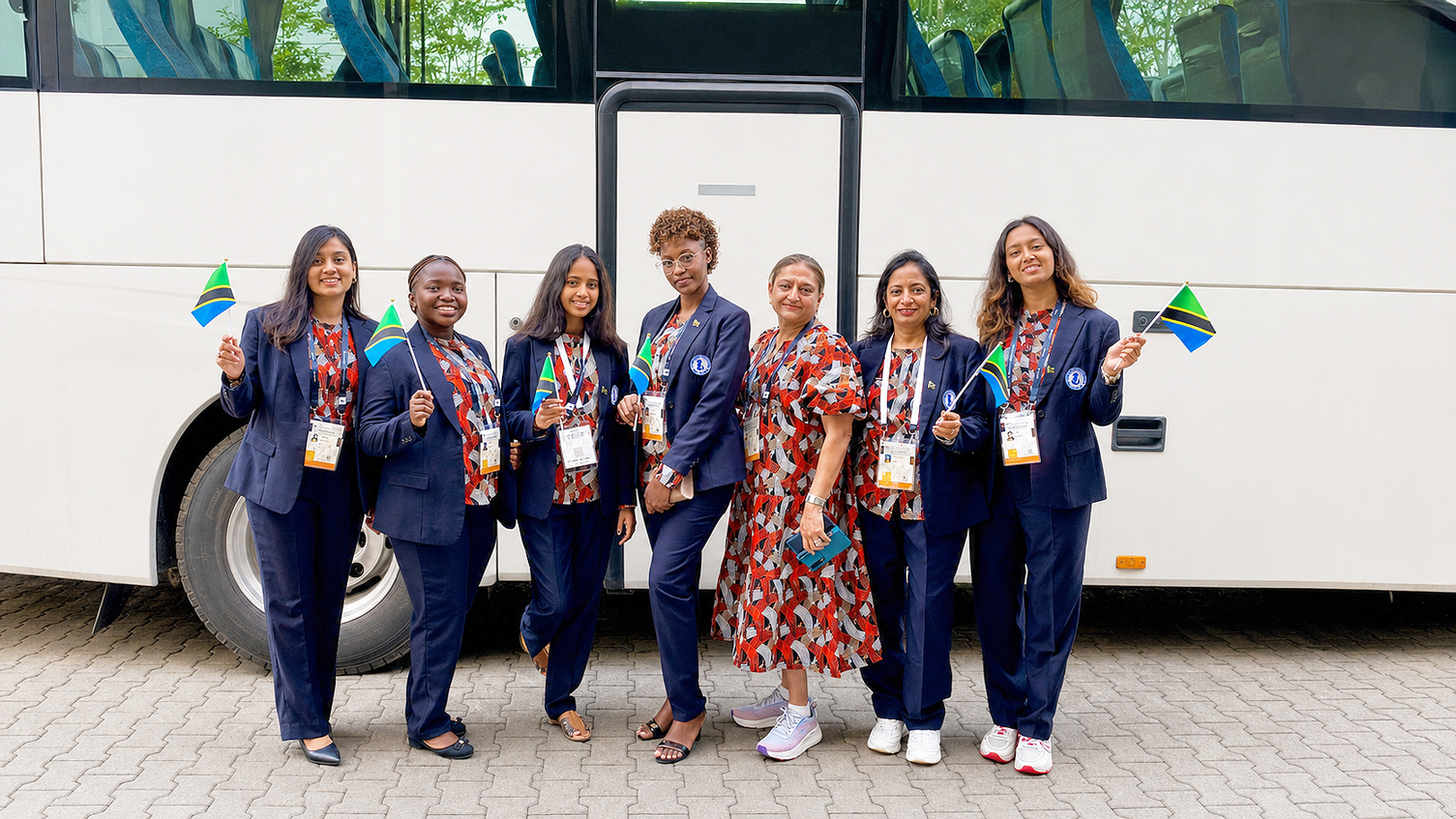
Ratings can measure a player’s performance, tournament standings can record her results and team lists can confirm her selection. Yet none of these numbers fully explains the quality Lissa Siya Joseph believes defines Tanzania’s Women’s Chess Team.
That quality is resilience.
“We fight for every game,” she says. “We take every game seriously, and we support one another.”
The statement captures both the competitive character of the team and the wider conditions through which its players have emerged. Tanzania’s women are not only preparing to face opponents across the board. Many have also had to overcome limited access to structured coaching, regular tournaments, strong practice partners, sponsorship and international exposure.
Before a woman competes against another country, she may first have to defeat the idea that chess was never intended for her.
Lissa encountered that assumption early in her journey. When she met a fellow Tanzanian during an online game, he was surprised to discover that his opponent was a woman.
“Are there even girls playing chess in Tanzania?” he asked.
The question became a bridge into the country’s chess community, but it also revealed a deeper problem. Female players existed, yet they were still not visible enough for their presence to appear ordinary. A girl could be interested in chess and still struggle to identify a woman competing at national level, a nearby coach willing to guide her or a clear pathway connecting curiosity to serious competition.
Lissa wants the next girl’s arrival to be less surprising.
“Chess is not a gender-based sport,” she says. “It is a mental sport.”
The board does not assign different movements to pieces according to the player’s gender. The clock offers no additional time to men, and a tactical idea does not become less accurate because a woman calculated it. Chess tests preparation, concentration, creativity, discipline and the ability to make decisions under pressure.
Social expectations, however, can shape who receives the opportunity to develop those abilities.
A boy who shows curiosity may be encouraged to compete. A girl displaying the same interest may be treated as though chess were simply a temporary hobby. Without sustained encouragement, access to coaching or visible examples of women succeeding, early enthusiasm can disappear before talent has the opportunity to reveal itself.
The scale of the challenge can be seen in Tanzania’s player statistics. In the March 2026 FIDE rankings, only four Tanzanian women were listed as active rated players: Prisha Chheda, Mahi Shah, Lissa Siya Joseph and Anahi Rishit Shah. Lissa’s rating stood at 1499. Tanzania’s overall world ranking had improved from 166th to 164th, while its total number of active rated players had risen from 21 to 27. The progress was encouraging, but the small number of active rated women showed how narrow the competitive pathway remained. The Guardian’s report placed Lissa among Tanzania’s leading active women players.
Those figures do not indicate an absence of potential. They reveal how much potential still needs to be reached.
Lissa believes girls should accept opportunities to train, enter tournaments and allow themselves to be seen. Her own story demonstrates what can happen when curiosity is supported rather than dismissed. She discovered chess independently, learned online, entered national competition as a beginner and reached the Olympiad. Her mother and twin sister helped her continue when she doubted herself, lending her belief before she could consistently produce it on her own.
But individual determination cannot carry the entire responsibility for developing women’s chess.
Tanzania needs stronger systems: chess clubs in schools and universities, trained coaches, mentorship from experienced players, regular women’s competitions, financial support and greater access to regional and international tournaments. Girls must be introduced to the game early, but they must also find meaningful opportunities to continue once their interest becomes serious.
Visibility tells a girl that participation is possible.
Structure gives her somewhere to go after she believes it.
Within the national team, support between players becomes especially important. Although they compete individually across separate boards, their results contribute to a shared national performance. A difficult defeat affects one player emotionally, but it can also influence the atmosphere surrounding the entire squad. Encouragement, therefore, is not merely a gesture of friendship. It is part of the team’s competitive strength.
Resilience means returning to the board after disappointment. It means continuing to calculate when the position becomes uncomfortable, refusing to treat a stronger opponent’s rating as a prediction and remembering that the team’s responsibility extends beyond a single game.
In Samarkand, Tanzania’s women will face teams supported by deeper chess cultures and stronger preparation systems. Some opponents will arrive with professional coaches, extensive databases and years of international competition behind them. Lissa and her teammates cannot change those advantages once the clocks begin.
They can decide how they respond to them.
They will fight for each position, support one another and carry the ambitions of girls who may be watching an Olympiad for the first time. Their presence will answer the question Lissa once heard online more powerfully than any explanation could.
Yes, Tanzanian women play chess.
And when they reach the board, they keep fighting.
Next: Chapter Nine — What an Olympian Needs


No comments yet. Be the first to share your thoughts.