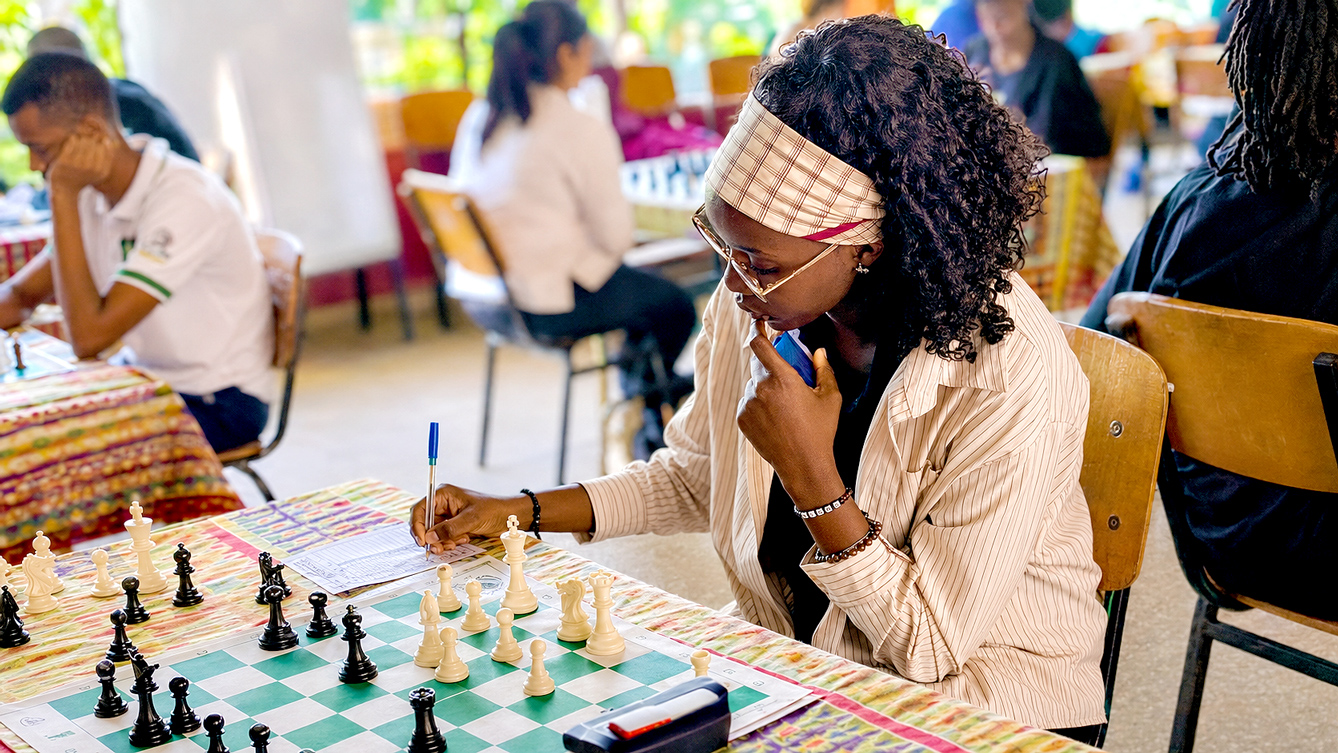
When Lissa Siya Joseph entered her first serious chess tournament, she carried something unusual into the competition: almost no tournament experience.
The other players appeared to understand the environment naturally. They knew the procedures, recognised one another and seemed comfortable with the tension of formal competition. Lissa, by contrast, was still finding her place in Tanzania’s chess community. She had learned the game online, initially without a coach, and was now being asked to translate that private learning into performance across a physical board.
For the first time, her ability would be measured publicly.
She wanted to win, but ambition did not silence uncertainty. As the tournament progressed, Lissa became increasingly conscious of how new she was. She was competing against players who appeared stronger, more experienced and more familiar with the pressure surrounding national competition. At times, the distance between them seemed wider than the chessboard separating their pieces.
“I felt like I was the only person who was new to the chess community,” she remembers. “There was a point when I felt I really could not do it.”
That private doubt never appeared on the results sheet. Neither did the conversations that helped her return to the board after difficult games.
Her mother and twin sister followed her progress closely. Between rounds, they encouraged her, reminded her of what she had already achieved and continued believing in her when her own confidence weakened. They could not calculate variations or rescue a difficult position, but they gave her something equally important: emotional stability.
Their confidence became a place she could borrow courage from.
Before decisive games, Lissa tried to keep her message to herself simple. She had to remain composed, continue pushing and trust that improvement was possible. There was no single dramatic move when she suddenly knew that success was within reach. Her progress came through something less cinematic but more demanding: surviving the pressure of one game, then returning to face another.
Competitive chess rarely rewards a player for how nervous, inexperienced or overwhelmed they feel. The board records only the decisions they make. A brilliant idea from a beginner counts just as much as one from a veteran, while a careless mistake receives no sympathy because the player is new.
Lissa had to learn quickly.
She finished the tournament in fifth place, level on points with the player immediately above her. For someone accustomed to measuring achievement only through trophies, fifth might have appeared unremarkable. For Lissa, it meant something much larger. She had arrived as a self-taught newcomer, uncertain whether she belonged in the room, and completed the competition among the leading players.
The result placed her on the path towards selection for Tanzania’s team at the 2024 Chess Olympiad in Budapest.
“When I qualified, it was an unforgettable feeling,” she says. “I felt very proud. I could not believe it because I was still very much a beginner. It was my first tournament, and I was not expecting that.”
The first people she contacted were her mother and twin sister—the two people who had encouraged her after every game and continued expecting something from her even when she had begun expecting less from herself. The news did not belong to Lissa alone. It was also a reward for the quiet faith that had surrounded her throughout the competition.
Qualification transformed the meaning of her first tournament. She had not merely participated or gained experience. She had opened a route from an online chess platform to the international stage, moving with remarkable speed from teaching herself the game to earning the opportunity to represent her country.
Yet the achievement did not mean she had mastered chess. If anything, it revealed how much more there was to understand. The stronger the competition became, the more clearly she could see the weaknesses hidden inside her play. Every victory offered confidence, but every difficult position exposed another area requiring attention.
That tension, between pride in how far she had come and awareness of how far she still had to go, would follow her to Budapest.
Lissa had entered her first tournament wondering whether she belonged.
She left it as a Tanzanian Olympian.
Next: Chapter Three — Budapest, the First Education


No comments yet. Be the first to share your thoughts.