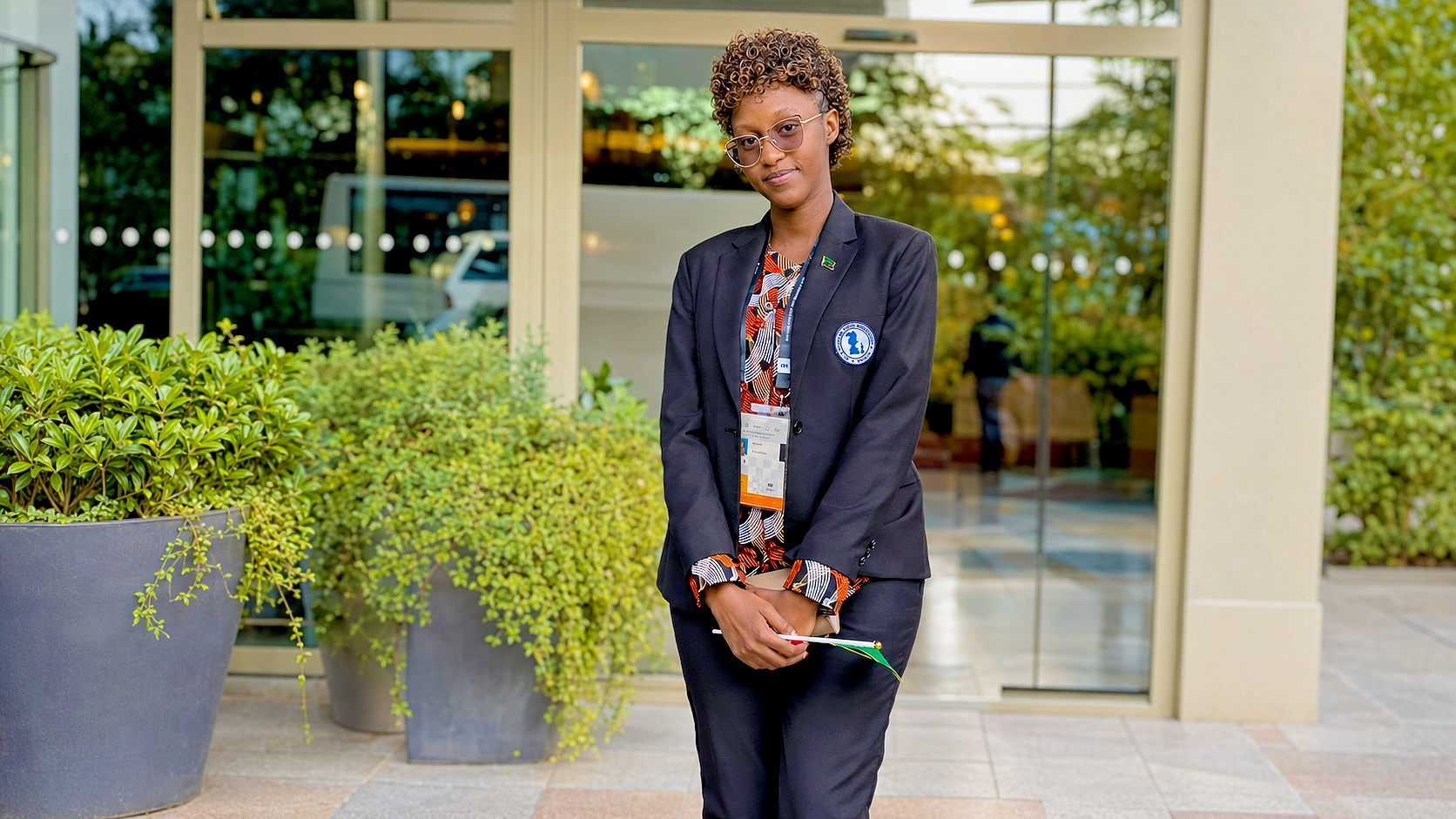
When Lissa Siya Joseph arrived in Budapest for the 2024 Chess Olympiad, she carried the pride of representing Tanzania, and the unmistakable awareness that she was still new to competitive chess.
Only a short time earlier, chess had existed mainly on her screen. She had taught herself the game online, found her way into Tanzania’s chess community and entered her first serious tournament with little experience of formal competition. Finishing fifth had opened an unexpected door. Now, beyond that door, stood one of the largest and most demanding stages in world chess.
The Olympiad was no longer an ambition she could imagine from a distance. It was an arena she had to enter, one move at a time.
Budapest brought together players shaped by different chess cultures. Some came from countries with established coaching systems, regular training camps and strong international competition. Many had spent years playing tournaments, studying opponents and becoming comfortable under the pressure of representing their nations.
For Lissa, the experience was both exhilarating and exposing.
Across the board, enthusiasm alone was not enough. Every position demanded accuracy. A small weakness could become a lasting disadvantage, while one careless decision could undo hours of concentration. Opponents arrived with unfamiliar styles, carefully prepared openings and the confidence of players accustomed to international competition.
The Olympiad showed Lissa how much chess can be contained within a single move.
A decision that appeared simple could depend on several possible responses. A promising attack could fail because of one overlooked defensive resource. A position that seemed quiet could conceal a tactical threat. At that level, it was not enough to see what was happening on the board. She had to visualise what the board might look like several moves later.
Budapest therefore became more than Lissa’s first Olympiad.
It became her first international classroom.
Every game taught her something different. Some positions tested her calculation; others challenged her patience, time management and emotional control. There were moments when she played with confidence and others when the difference between national competition and the world stage became impossible to ignore.
The lessons did not end when she left the playing hall. Each completed game became a record she could later revisit, an honest account of the decisions she had made under pressure. The moves showed where she had understood the position, where opportunities had escaped her and where uncertainty had interrupted her thinking.
Those games remain central to her preparation for Samarkand.
“I analyse my past games, my Olympiad games and my national games,” she explains. “I start with my weaknesses.”
This approach reveals how Budapest changed her. Before her first Olympiad, Lissa was learning what it meant to reach the international stage. Now, she is learning how to return as a stronger and more self-aware competitor.
Her analysis has drawn particular attention to the middlegame. She is comfortable with her opening preparation, but once the familiar sequence ends and the position begins demanding independent decisions, calculation and visualisation become more important.
“I am not worried about my openings,” she says. “It is the middlegame, calculation and visualisation, that needs more attention.”
The middlegame is where preparation meets uncertainty. The opening may provide a map, but eventually the player must continue without it. Plans compete, threats emerge and each move changes the logic of the position. A player must calculate variations without moving the pieces, hold possible positions in the mind and judge which future is worth pursuing.
For Lissa, recognising this weakness is not an admission of defeat. It is the beginning of deliberate improvement. Tactical exercises, endgame study and repeated analysis are helping her strengthen the parts of her game that Budapest revealed most clearly.
The Olympiad also taught her that international chess is deeply psychological. Players do not arrive at the board carrying only their openings, ratings and previous results. They bring expectations, nerves, fatigue and fear. A strong opponent can create pressure before making a single move, especially when their style is unfamiliar and their preparation unknown.
Lissa learned that she had to manage not only the position, but also herself.
That lesson will matter in Samarkand. She will again face opponents whose backgrounds, styles and preparation may be unfamiliar. The difference is that she will no longer be experiencing the Olympiad for the first time. She now understands its scale, intensity and demands.
Her second qualification was therefore different from the first. In 2024, selection felt almost unbelievable. She had entered the national competition as a beginner and exceeded her own expectations. This time, she prepared with a clearer understanding of what qualification required, even while balancing the demands of university and chess.
“I was expecting it because I had been preparing,” she says. “It was really tough, but I was still expecting to qualify.”
Budapest did not give Lissa a completed chess education. It gave her something more useful: a clearer view of the player she was and the player she needed to become.
She went there to represent Tanzania.
She returned with a syllabus for her future.
Next: Chapter Four — Between the Laboratory and the Chessboard


No comments yet. Be the first to share your thoughts.