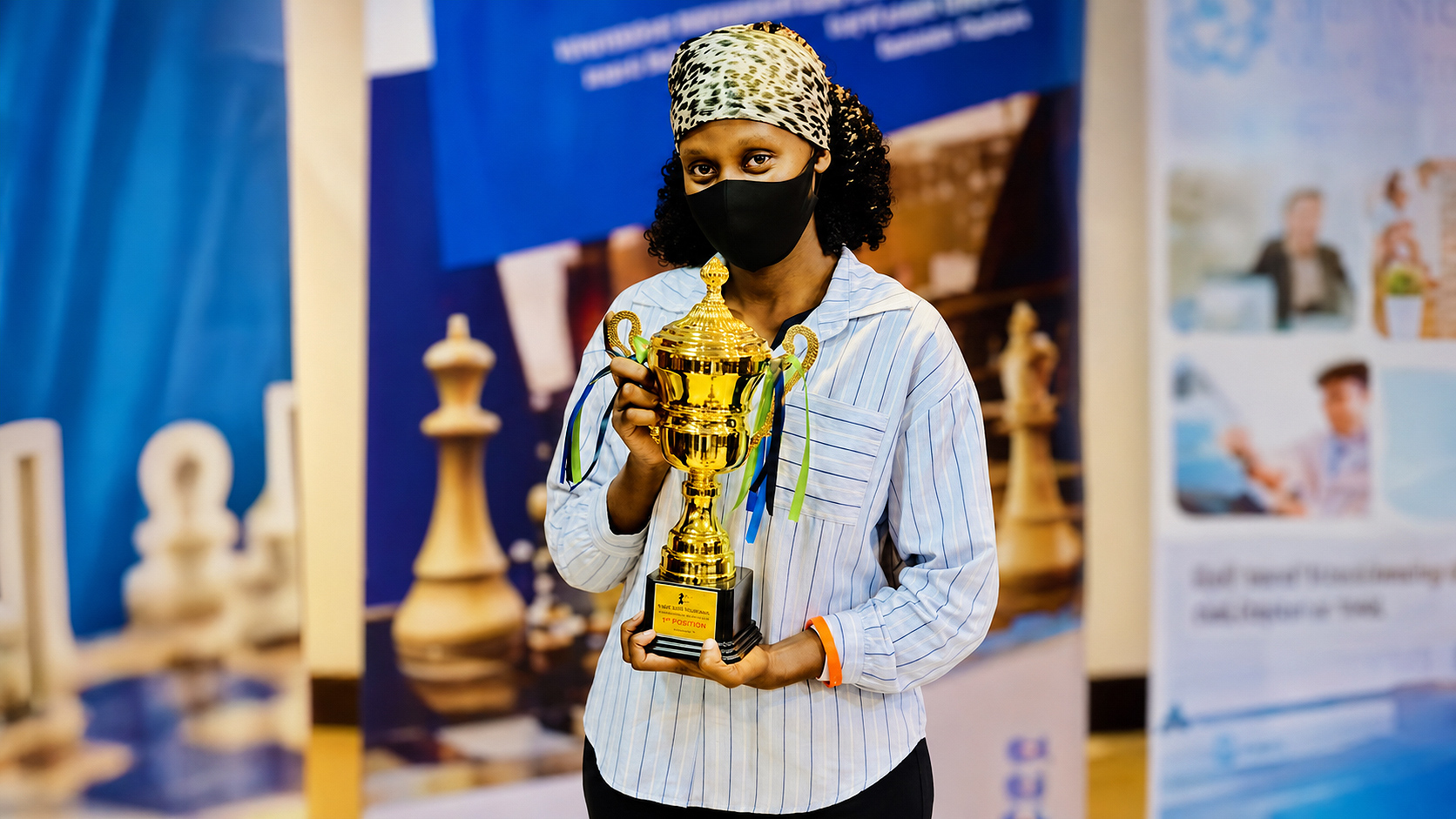
When Lissa Siya Joseph sits down at the Chess Olympiad in Samarkand, her name will not appear alone.
Beside it will be the Tanzanian flag.
To spectators following the tournament, it may look like a small digital symbol, a familiar combination of green, gold, black and blue displayed beside a player’s name, federation and rating. For Lissa, it carries the weight of an entire journey: the online chessboard where she taught herself to play, the embarrassing first encounter with physical pieces, the national tournament she entered as a beginner and the family members who continued believing when her confidence weakened.
The flag represents where she comes from, but it also reminds her why she is there.
“Representing Tanzania means a lot to me,” she says. “I want to make my country proud.”
In Samarkand, every move will belong to Lissa, but its meaning will extend beyond her. She will be one of the women carrying Tanzania into a competition that brings together different languages, cultures, playing styles and chess traditions. Across the board may sit an opponent supported by years of professional coaching and regular international exposure. Around them will be teams from countries where chess is deeply embedded in schools, clubs and national sporting systems.
For a few hours, however, those larger differences will be compressed onto sixty-four squares.
There, Lissa will not be the student balancing laboratory medicine with chess preparation, the beginner who once struggled to recognise pieces on a physical board or the player who questioned whether she belonged in international competition. She will be Tanzania’s representative, responsible for the position before her and the decisions required by it.
That responsibility brings pressure, but it also offers freedom. Once the game begins, speculation disappears. Ratings cannot move pieces. Reputation cannot calculate variations. The quality of the position must be tested through the choices each player makes.
Lissa has earned the right to make hers.
Her journey to a second Olympiad matters because it was never carefully designed for her. No one placed a chessboard in her hands during childhood and announced that she might one day represent Tanzania. She discovered the game while searching for a productive way to sharpen her mind. Curiosity led to online matches; those matches led to Tanzania’s chess community; a first tournament led to Budapest; and the lessons of Budapest helped guide her back into national competition.
Six points across nine rounds secured her ticket to Samarkand.
Yet the deeper achievement is not simply that Lissa qualified twice. It is that she continued growing after the surprise of her first qualification. Budapest could have remained an extraordinary event, a remarkable chapter in the life of a self-taught beginner. Instead, she treated it as an education. She returned to her games, identified weaknesses and began preparing for another opportunity.
Her second Olympiad is therefore not a repetition of the first.
It is evidence of development.
The Lissa travelling to Samarkand understands international competition more clearly. She knows the danger of intimidation, the importance of middlegame calculation and the emotional discipline required after a mistake. She knows that a player cannot remain trapped inside a lost opportunity while the current position continues demanding attention.
She also knows that preparation is not carried by the player alone. Her mother and twin sister encouraged her through the uncertainty of her first national competition. Teammates created a community in a sport that initially seemed solitary. Other Tanzanian players helped her move from online chess into organised competition. Every person who offered guidance, belief or opportunity became part of the road leading towards Samarkand.
The flag beside her name belongs to them too.
It also belongs to the girls who have not yet discovered chess. Some may encounter it through a school club. Others may find the game online, just as Lissa did. They may begin without coaching, equipment or visible examples of Tanzanian women competing internationally. Their first moves may be uncertain, and their earliest defeats may feel like evidence that they are not talented enough.
Lissa’s story offers another interpretation.
A difficult beginning does not define the distance a person can travel.
Her journey does not pretend that determination solves every structural challenge. Tanzanian chess still needs stronger coaching, more regular tournaments, greater international exposure and sustained support for women and young players. Talent cannot develop indefinitely on encouragement alone. If the country wants more Olympians—and stronger performances when they arrive, it must invest in the pathway between curiosity and excellence.
But Lissa demonstrates what may already be waiting inside that pathway.
She is a laboratory medicine student who became an Olympian. A self-taught player who established a university chess club. A creative knight learning to carry herself with the confidence of a queen. Her story contains no perfect progression, only curiosity strengthened by persistence and opportunities met with courage.
That may be her most important lesson to others.
You do not need to see the entire route before making the first move.
In Samarkand, Lissa hopes to play good chess, gain experience and make Tanzania proud. Some games will reward her preparation. Others may reveal weaknesses that still require attention. There will be victories to study honestly, defeats to recover from and positions that test whether the unseen player inside her has become stronger.
Whatever the results, she will return with new knowledge.
That is how her journey has always advanced: one discovery creating the next question, one competition revealing the next level and one difficult position teaching her to look again.
Before chess, Lissa was searching for something that could sharpen her mind.
She found a game that changed her life.
Now, when she sits at the Olympiad board and looks across at her opponent, the pieces will no longer feel unfamiliar. She will understand the setting, the pressure and the responsibility. She will know that she belongs, not because the journey was easy, but because she earned her place through every uncertain step that brought her there.
Then the clock will begin.
Lissa will make her move.
And beside her name, Tanzania will move with her.


No comments yet. Be the first to share your thoughts.