Lissa Siya Joseph is not travelling to Samarkand with a promise to win every game.
She understands chess too well for that.
At the Olympiad, she will encounter experienced opponents from different countries, each carrying her own preparation, ambitions and reasons for wanting to succeed. Some will arrive with higher ratings, professional coaching and years of international competition. Others may be participating for the first time, bringing the same mixture of pride and uncertainty that Lissa carried into Budapest in 2024.
The outcome of any individual game cannot be guaranteed.
What Lissa can control is the quality of chess she brings to the board.
“I want to play good chess, gain experience and make Tanzania proud,” she says.
The statement may sound modest beside the language usually associated with international sport. Athletes are often expected to predict medals, promise victories or speak as though confidence requires certainty. Lissa’s ambition is more measured, but it is not less demanding. Playing good chess means turning months of preparation into clear decisions while the clock is running and the pressure is real.
It means remembering the lessons Budapest gave her.
In her first Olympiad, Lissa discovered how quickly a small inaccuracy could grow into a serious problem. She experienced unfamiliar openings, stronger competition and the psychological weight of facing players shaped by established chess systems. Those games showed her that international performance depends not only on what a player knows, but also on whether she can access that knowledge when the position becomes difficult.
Samarkand is an opportunity to respond differently.
Lissa wants to calculate more accurately through the middlegame, visualise positions more clearly and recover more quickly when a move does not work as intended. She wants to respect her opponents without allowing their ratings to decide the game before it begins. Above all, she wants her moves to reflect the player she has been working to become since returning from Budapest.
For her, a good game is not defined only by the final result. A victory produced through careless play may still expose serious weaknesses, while a defeat against a strong opponent can contain evidence of improvement. The result matters, especially in a team competition, but so does the quality of the decisions that produced it.
This is why Lissa analyses her games immediately after playing.
A win does not allow her to ignore what went wrong. Instead of celebrating for long, she begins investigating the position. Where did the advantage emerge? Which move could have been stronger? Did she calculate accurately, or did the opponent simply fail to punish a mistake?
Her instinct is to turn every completed game into another lesson.
That habit will be essential during the Olympiad, where rounds follow one another and there is little time to remain emotionally attached to the previous result. A painful defeat must be studied without being carried into the next game. A satisfying victory must build confidence without producing carelessness. Each morning brings a new opponent, a new position and another responsibility to the team.
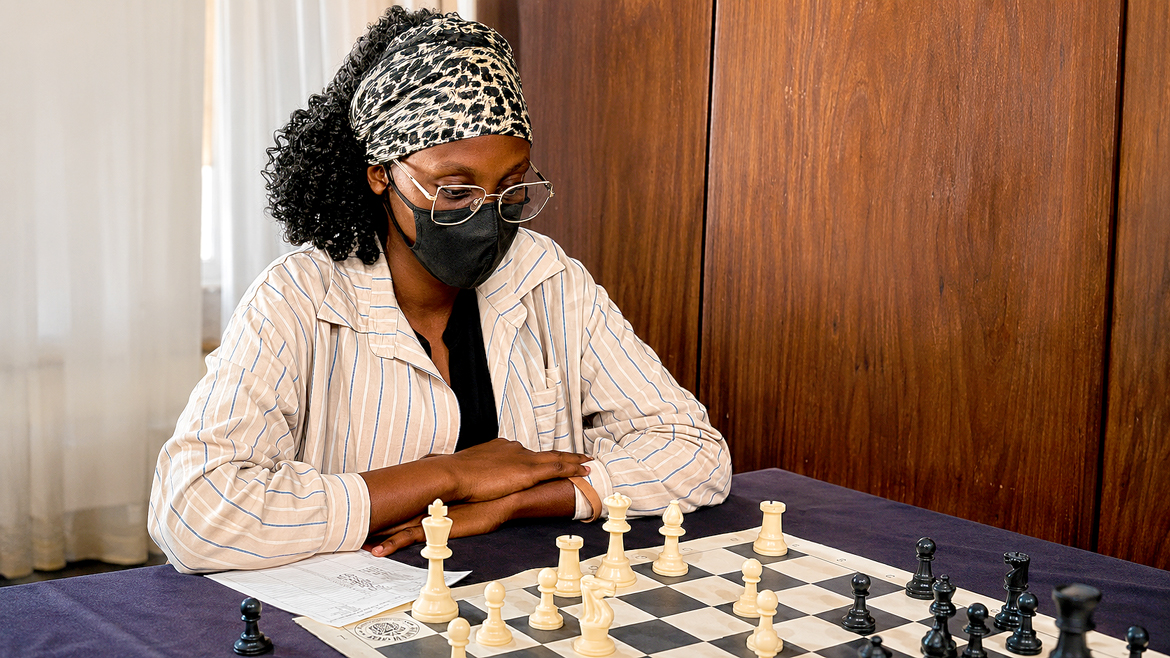
Lissa will travel with one small object that reflects this approach: her chess notebook.
Inside it are ideas, observations and lessons gathered through training and competition. In an era of digital databases and online analysis, the notebook offers something more personal. It records not only moves, but the evolution of a player learning how she thinks.
Samarkand will add new pages.
The Olympiad will also test Lissa’s preferred style. She describes herself as defensive and calculation-oriented, a player willing to remain patient and search for resources in uncomfortable positions. Yet playing good chess may sometimes require her to step beyond that familiar identity, to recognise when a position demands aggression, when caution has become hesitation and when an opportunity must be seized before it disappears.
That is where the creative knight and the confident queen meet.
The knight represents the unconventional path that brought her into chess: online discovery, self-teaching and progress through routes no one had prepared for her. The queen represents the confidence and influence she is still developing. In Samarkand, she will need both, the imagination to find unexpected possibilities and the courage to trust them.
Making Tanzania proud will not rest on one spectacular move. It will be expressed through discipline: arriving prepared, fighting for every position, supporting her teammates and carrying herself with dignity regardless of the result. It will mean recognising that the flag beside her name represents more than personal ambition.
Girls discovering chess in Tanzania may follow her games. University students she has introduced to the sport may see their teacher competing on the world stage. Her mother and twin sister, the people who believed in her during her uncertain first tournament, will once again watch the journey continue.
Lissa cannot control what every game will give her.
She can control whether she arrives ready to learn, ready to fight and ready to make decisions worthy of the opportunity she earned.
Her goal is simple to say and difficult to achieve.
Play good chess. Gain experience. Make Tanzania proud.
Next: Chapter Eleven — The Flag Beside Her Name


No comments yet. Be the first to share your thoughts.