

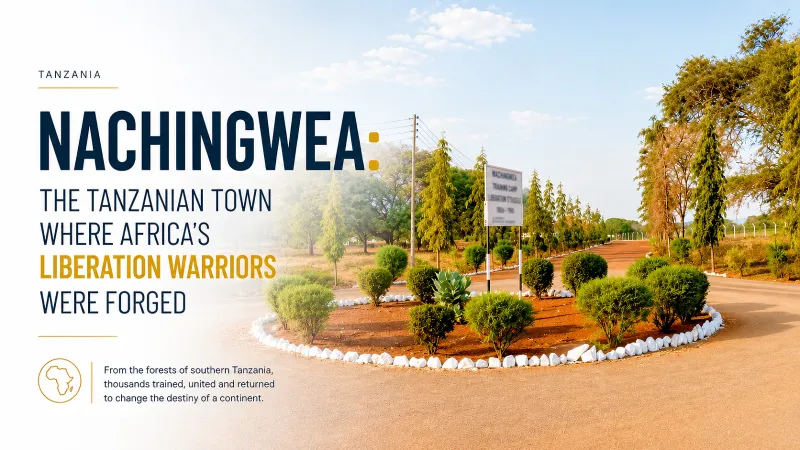
NACHINGWEA, Tanzania — The roads leading into Nachingwea wind through dense woodlands, fertile farmland and quiet villages in southern Tanzania. Today, little disturbs the calm. Farmers tend their fields, motorcycles weave through the town, and life moves at an unhurried pace.
Nothing about the landscape immediately reveals that this unassuming town once stood on the front line of one of Africa's greatest political transformations.
Yet for more than a decade, Nachingwea was where thousands of young Africans arrived carrying little more than hope, and left carrying the knowledge, discipline and determination to help liberate an entire continent.
This was not merely a military camp.
It was a crucible where revolutions were shaped, future presidents found purpose, military commanders learned leadership and the dream of a free Africa became a shared mission.
Long before Mozambique, Zimbabwe, Namibia and South Africa celebrated independence, the road to freedom passed quietly through southern Tanzania.
After Tanganyika won independence in 1961 and united with Zanzibar three years later, President Julius Nyerere advanced a bold conviction: Tanzania could not consider itself truly free while millions of Africans remained under colonial rule, apartheid and white-minority governments.
It was a principle that would define the country's place in African history.
Rather than turning inward to focus solely on its own development, Tanzania opened its borders, committed its scarce resources and transformed itself into the operational heart of the continent's liberation movements.
Dar es Salaam became the diplomatic capital of African freedom.
Nachingwea became one of its military academies.
By the late 1960s, the town had evolved into a strategic training centre where liberation fighters from across southern Africa gathered before returning to confront some of the world's most heavily armed colonial regimes.
Among those who trained here were members of Mozambique's FRELIMO, Zimbabwe's ZANU and ZAPU, Namibia's SWAPO, and South Africa's African National Congress (ANC).
They arrived speaking different languages, carrying different histories and fighting different battles.
They left united by a common purpose.
The training was demanding.
Recruits mastered guerrilla warfare, navigation, communications, logistics, engineering, field medicine and survival techniques. They learned how to operate under extraordinary pressure, often preparing for campaigns that would take them deep into hostile territory.
But Nachingwea taught something even more enduring than military tactics.
Its instructors understood that independence would eventually be won, and that the greater challenge would begin the day after victory.
Political education became as important as battlefield training.
Future leaders studied governance, national unity, public service, discipline and the responsibilities of building democratic institutions after liberation. The objective was never simply to defeat colonial rule; it was to prepare a generation capable of governing sovereign nations.
In many ways, Nachingwea became a university of African statehood.
Among the movements most closely linked to the town was Mozambique's FRELIMO.
Southern Tanzania served as the movement's strategic rear base throughout the struggle against Portuguese colonial rule. From camps around Nachingwea, fighters crossed into northern Mozambique, launching operations that gradually weakened colonial control and helped pave the way for independence in 1975.
For countless young recruits, these forests marked the final place of safety before crossing into war.
Some never returned.
Others would later lead the nations they helped liberate.
As liberation movements expanded, Nachingwea evolved beyond a training facility into a meeting ground for future statesmen, diplomats and military commanders. Relationships forged around campfires and training grounds would later shape regional diplomacy, defence cooperation and the institutions of newly independent African states.
The town became a living expression of Pan-Africanism, not as an abstract philosophy, but as a practical commitment shared across borders.
What made Tanzania's role particularly remarkable was the scale of its sacrifice.
Still a young nation with limited financial resources, Tanzania dedicated land, infrastructure, security and logistical support to liberation movements from across southern Africa. The policy imposed significant economic burdens and diplomatic risks, yet successive governments maintained that African freedom was indivisible.
If one nation remained oppressed, the continent's liberation remained unfinished.
History would ultimately vindicate that belief.
As colonial administrations collapsed across southern Africa and apartheid eventually came to an end, many of the leaders who assumed positions of national responsibility had once walked the training grounds of Nachingwea.
Its influence stretched far beyond Tanzania's borders.
Although the guns have long fallen silent, historians continue to regard Nachingwea as one of the indispensable pillars that sustained Africa's liberation struggles during their most difficult years. Without secure rear bases such as this, many movements would have struggled to recruit, organise, train and survive prolonged conflicts against far better-equipped opponents.
Yet despite its continental significance, Nachingwea remains one of Tanzania's least-known historical treasures.
Scholars, veterans and heritage specialists increasingly argue that its story deserves wider recognition through museums, memorials, research centres and educational programmes that preserve the legacy of the liberation era. Beyond safeguarding history, they see an opportunity to position Nachingwea as a destination for Pan-African heritage tourism, a place where future generations can understand how solidarity reshaped a continent.
Today, the training grounds are quieter than they have been in decades.
The sounds of marching boots have been replaced by birdsong and the rhythm of rural life.
But history still lingers in the landscape.
Every independent flag flying across southern Africa carries, in some measure, the legacy of this small Tanzanian town. Nachingwea reminds us that the struggle for freedom was never fought by nations in isolation. It was built on shared sacrifice, common purpose and an unwavering belief that the liberation of one African people depended upon the liberation of all.
In that quiet corner of southern Tanzania, Africa did more than train soldiers.
It prepared the architects of its own freedom.
Updated October 16, 2026


Be the first to share your thoughts.