

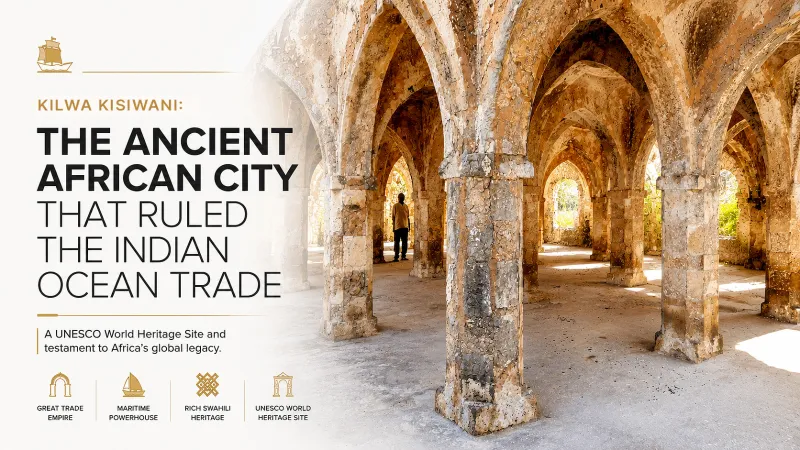
KILWA KISIWANI, Tanzania — At dawn, the Indian Ocean is almost silent.
Gentle waves wash against coral cliffs where crumbling stone walls have stood for centuries. Sunlight filters through graceful arches of an ancient mosque, illuminating pillars carved from coral rock. Birds nest where merchants once negotiated fortunes, and the only footsteps belong to curious travellers wandering through the quiet ruins.
It is difficult to imagine that this peaceful island was once among the busiest commercial centres on Earth.
Yet for nearly four centuries, Kilwa Kisiwani was the beating heart of one of the world's greatest maritime trading networks, an African city whose influence stretched from the goldfields of southern Africa to the imperial courts of China.
Long before European empires dominated the seas, Kilwa had already mastered global commerce.
The city rose to prominence between the twelfth and fifteenth centuries, becoming the jewel of the Swahili Coast. Perfectly positioned along the East African shoreline, it prospered by harnessing the rhythm of the Indian Ocean's monsoon winds. Every season, fleets of wooden dhows arrived from Arabia, Persia, India and beyond, their sails carrying traders, scholars, sailors and ideas across continents.
Kilwa was where worlds met.
From the African interior came gold from the Kingdom of Zimbabwe, ivory, iron, timber, tortoiseshell and precious animal products. From distant civilizations arrived Chinese porcelain, Persian ceramics, Indian cotton textiles, spices, beads, glassware and luxury goods that found eager buyers across Africa.
The island became more than a marketplace.
It became the financial gateway linking Africa to the wider Indian Ocean economy.
Its merchants accumulated extraordinary wealth, while its rulers extended influence across much of the Swahili Coast. Ports from modern-day Mozambique to Kenya looked to Kilwa as both a commercial partner and a political power.
Prosperity transformed the island into one of medieval Africa's most sophisticated urban centres.
Master builders quarried coral stone from the surrounding reefs and constructed elegant homes, warehouses, palaces and mosques whose architecture rivalled many contemporary cities elsewhere in the world.
At the centre stood the Great Mosque of Kilwa.
Expanded over generations, it remains one of the oldest surviving mosques in sub-Saharan Africa. Its soaring vaulted ceilings, graceful arches and coral-stone craftsmanship reflected remarkable engineering skill, challenging outdated assumptions that medieval Africa lacked architectural sophistication.
Nearby rose Husuni Kubwa.
Perched dramatically above the ocean, the sprawling palace contained more than a hundred rooms, courtyards, reception halls, storage chambers and terraces overlooking the sea. It was among the largest pre-colonial stone structures in sub-Saharan Africa, a powerful symbol of wealth, governance and international prestige.
Kilwa's confidence extended even further.
The city minted its own gold and copper coins bearing the names of its rulers, demonstrating a sophisticated monetary system and a level of political organisation comparable to many of the world's leading trading states of the time.
Commerce in Kilwa was never simply about goods.
It was equally an exchange of knowledge, religion, language and culture.
Arab, Persian, African and Asian traditions blended to shape the vibrant Swahili civilization, producing a unique coastal culture whose influence still defines much of East Africa today. Kiswahili itself grew as the language of trade, diplomacy and everyday life across the region.
For centuries, Kilwa flourished.
Then history changed course.
In 1505, Portuguese forces under Francisco de Almeida seized the city as Portugal sought to control the lucrative Indian Ocean trade routes. The conquest disrupted centuries-old commercial networks, redirected maritime commerce and weakened Kilwa's economic dominance.
Trade gradually shifted elsewhere.
Political influence faded.
The magnificent city slowly surrendered to time.
Stone walls weathered beneath tropical rains. Palaces emptied. Harbours fell silent.
Nature reclaimed what commerce had built.
Yet Kilwa never truly disappeared.
Its ruins remain among Africa's greatest historical treasures, preserving the story of a civilization that demonstrated Africa's central role in the early global economy.
Recognising its universal significance, UNESCO inscribed the Ruins of Kilwa Kisiwani and nearby Songo Mnara as World Heritage Sites in 1981. Together, they stand as enduring monuments to the rise of Swahili civilization and centuries of cultural exchange across the Indian Ocean.
Today, archaeologists continue uncovering new evidence of Kilwa's remarkable past.
Fragments of Chinese porcelain, Persian pottery, imported glass, ancient coins and coral-stone foundations reveal a city whose connections extended thousands of kilometres beyond Africa's shores.
For historians, Kilwa overturns persistent myths that portray pre-colonial Africa as isolated from global economic systems.
Instead, it reveals an Africa that was entrepreneurial, outward-looking and deeply integrated into international commerce centuries before European colonial expansion.
Its merchants understood supply chains.
Its sailors mastered seasonal navigation.
Its leaders built institutions that supported trade, diplomacy and prosperity.
These are the very foundations upon which successful maritime economies continue to be built today.
For Tanzania, Kilwa Kisiwani represents far more than an archaeological site.
It is a reminder that the country's identity as a maritime nation did not begin with modern ports or contemporary shipping corridors. It is rooted in more than a thousand years of ocean commerce, international connectivity and commercial innovation.
As Tanzania expands the Port of Dar es Salaam, develops Bagamoyo, strengthens regional logistics corridors and invests in the Blue Economy, Kilwa's story feels remarkably contemporary.
The technologies have changed.
The ships are larger.
The trade routes are faster.
But the strategic advantage remains the same: connecting Africa to the world through the Indian Ocean.
Walking through Kilwa today, visitors encounter quiet courtyards, weathered pillars and coral-stone arches softened by centuries of sea breeze.
The silence is profound.
Yet beneath that silence echoes the memory of a city that once welcomed merchants from three continents, shaped the fortunes of kingdoms and proved that Africa was not on the margins of history, it was helping to write it.
Kilwa Kisiwani's greatest monument is not its mosque, its palace or its ancient walls.
It is the enduring story of an African civilization that embraced the sea, connected continents and built one of the earliest global trading economies the world has ever known.
Updated October 17, 2026



This article made me proud to be Tanzanian. More people need to know that our history helped shape global trade centuries ago.
Indeed... I wonder of this thread is know to the public.... great read.
Kilwa wasn't just a city, it was a gateway connecting Africa with Asia and beyond. Thank you for bringing this history back into the conversation.
Beautifully written. We often celebrate other civilizations while overlooking the incredible history we have here at home.
Reading this made me want to visit Kilwa again, this time with a completely different perspective. Tanzania has so many stories waiting to be rediscovered.
I had no idea Kilwa was once one of the world's most influential trading cities. This is the kind of history we should all learn in school. Excellent read.